Legal claim
Identify whether the token represents a fund share, note, beneficial interest, or another contractual claim.
A tokenized asset combines an off-chain legal and investment structure with on-chain records and transfer rules. The yield comes from the underlying portfolio; the token adds access, settlement, programmability, and a new set of dependencies.

Use the same comparison order every time: define the rate, translate it into dollars, map access, subtract friction, and identify the risk engine.
Identify whether the token represents a fund share, note, beneficial interest, or another contractual claim.
Verify holdings, duration, credit, valuation schedule, and the source of portfolio income.
Map issuer, vehicle, manager, custodian, transfer agent, cash account, and stablecoin rails.
Review upgrade keys, freezes, allowlists, minting roles, audits, and network dependencies.
Confirm who can redeem, when, at what NAV, in which currency, and with what fees.
Treat lending, pools, bridges, and receipt tokens as additional risk layers, not free utility.
These fields turn unlike product pages into a common worksheet. The table is educational and contains no live quotes.
| Wrapper question | Why it matters | Evidence to review |
|---|---|---|
| What do I legally own? | Defines rights in normal and stressed conditions | Offering and subscription documents |
| Where are assets held? | Determines custody and insolvency path | Custodian and account disclosures |
| How is yield paid? | Changes cash flow, tax, and compounding | Distribution and NAV policy |
| How do I exit? | Determines practical liquidity | Redemption terms and venue depth |
| Who controls the contract? | Creates upgrade and freeze authority | Code, audits, signer policy |
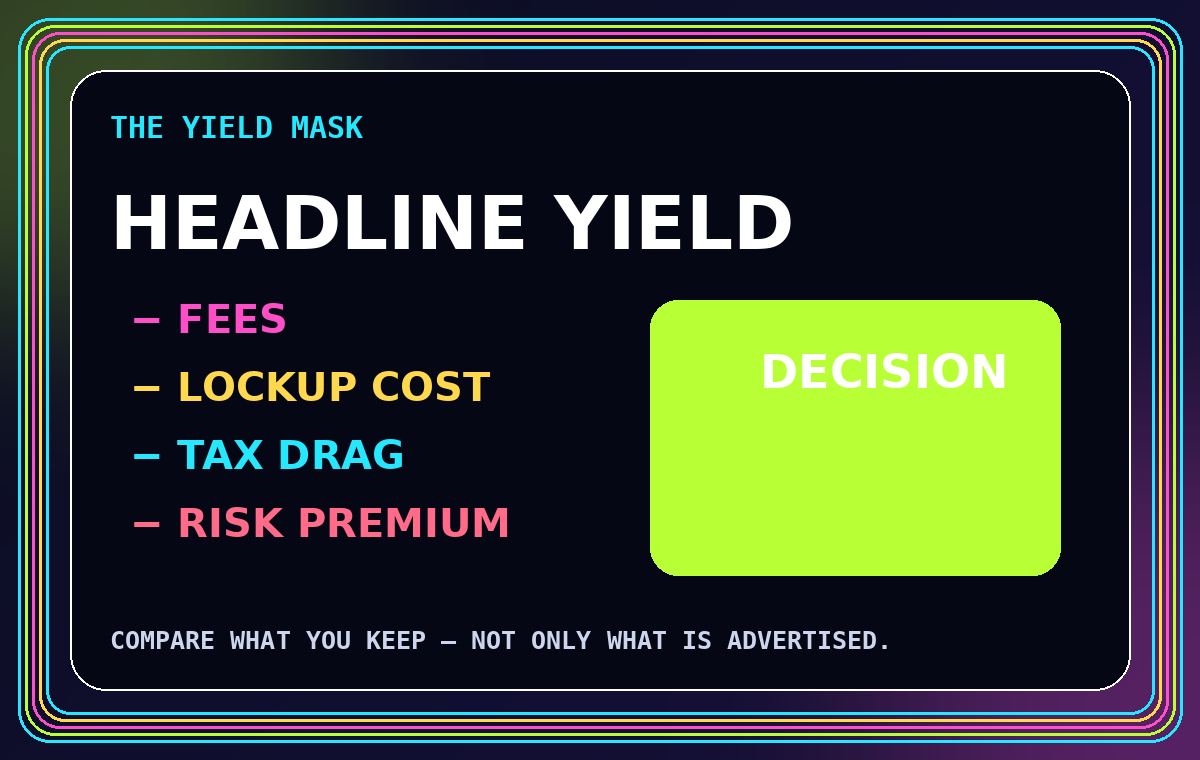
Each guide uses one authoritative external reference and links the mechanism back to practical comparison fields.
A due-diligence framework for tokenized Treasury funds and real-world assets covering legal claims, custody, liquidity, smart contracts, fees, and redemption.
Read the guide
Compare direct Treasury bills with Treasury and government money market funds across yield quotes, maturity, liquidity, fees, reinvestment, and account mechanics.
Read the guide
A layer-by-layer method for evaluating USDC and USDT income offers without confusing token reserves, platform rewards, lending risk, and DeFi incentives.
Read the guideRWA generally refers to tokenized claims connected to real-world assets or cash flows, but it is not a legal classification.
Not necessarily. The token may represent a fund share, note, or other claim that holds Treasury-related assets.
The token may transfer around the clock, while valuation, banking, and issuer redemption can still follow business schedules.