APY
Annual percentage yield reflects compounding under stated assumptions. It is most useful for deposit products when the balance remains in place for the modeled period.
Yield labels answer different questions. The Rate Lab helps you identify the metric, its time period, compounding assumption, liquidity terms, and risk source before comparing percentages across cash, funds, Treasury products, digital assets, and staking.
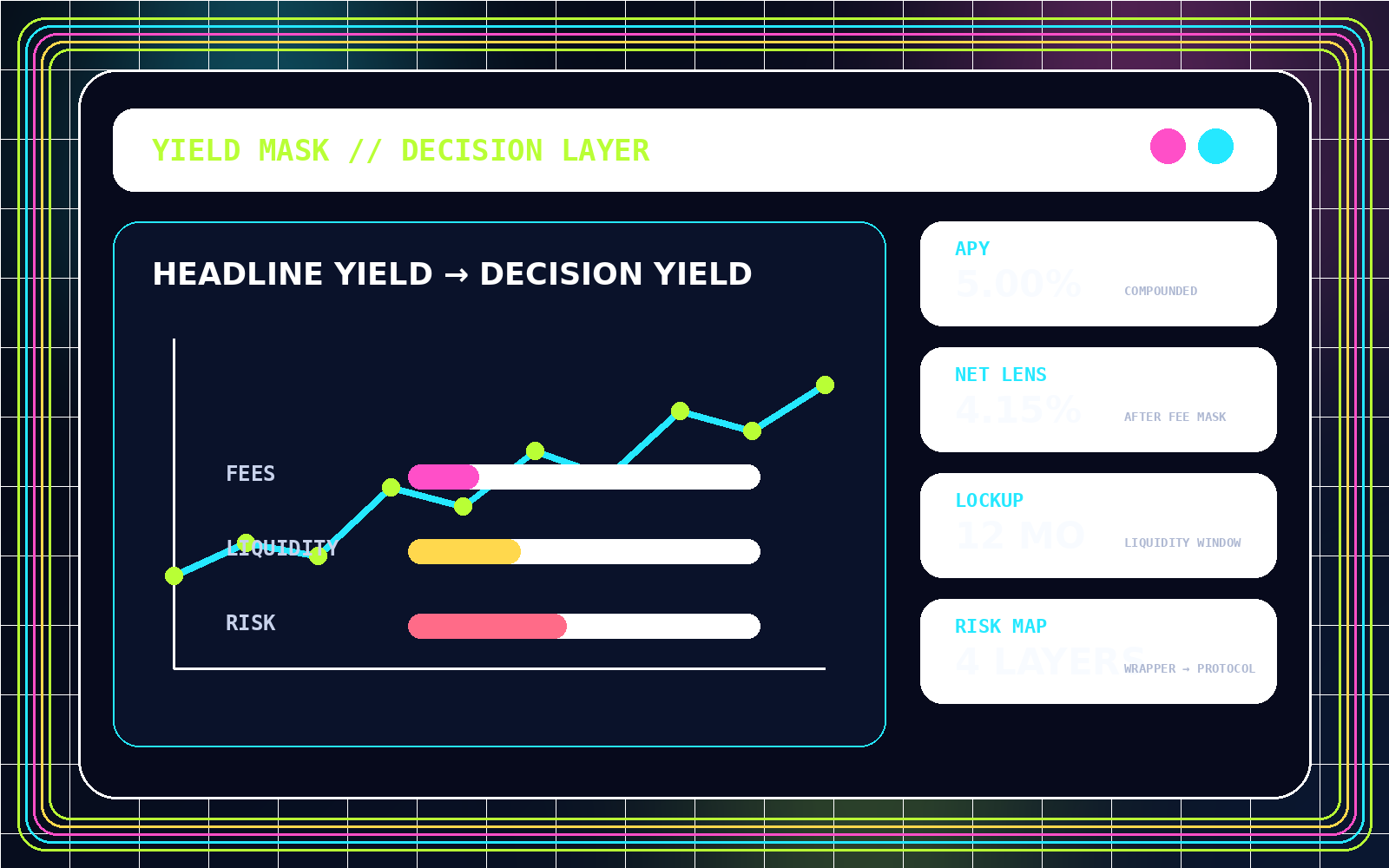
Use the same comparison order every time: define the rate, translate it into dollars, map access, subtract friction, and identify the risk engine.
Annual percentage yield reflects compounding under stated assumptions. It is most useful for deposit products when the balance remains in place for the modeled period.
A standardized recent-income measure used by many bond funds. It is not the same as a trailing distribution rate or a forecast.
Recent cash distributions annualized against a price or net asset value. The payment source and total return still require review.
A security yield tied to price, maturity, and quote convention. Compare dollar outcomes over the same dates, not unrelated annualized labels.
A variable native-token reward for proof-of-stake participation. Token price, validator fees, penalties, and exit timing remain separate.
A compounded estimate that can combine borrowing demand, trading fees, incentives, leverage, and assumptions that may change quickly.
These fields turn unlike product pages into a common worksheet. The table is educational and contains no live quotes.
| Metric | Best used for | What it can hide | Normalize with |
|---|---|---|---|
| APY | Deposits and fixed cash products | Penalties, caps, qualification rules | Term, balance tier, net fees |
| SEC yield | Bond-fund income comparison | Price volatility and future rate changes | Duration, credit, expenses |
| Distribution rate | Cash payout review | Return of capital and NAV erosion | Total return, payment source |
| Staking reward | Native-token accumulation | Token price, custody, exit delay | Net tokens, validator risk |
| DeFi APY | Protocol scenario analysis | Incentives, leverage, contract risk | Base yield, fees, loss cases |
Each guide uses one authoritative external reference and links the mechanism back to practical comparison fields.
Learn how to translate APY into estimated monthly income, distinguish simple yield from compounding, and model fees, taxes, rate changes, and withdrawals.
Read the guide
Learn why a large distribution rate is not the same as investment return, and how to compare income ETFs using yield definitions, fees, holdings, and total return.
Read the guide
A layer-by-layer method for evaluating USDC and USDT income offers without confusing token reserves, platform rewards, lending risk, and DeFi incentives.
Read the guideNo. APY and APR describe different contexts and assumptions. A higher number is not automatically a better product when fees, compounding, term, and risk differ.
Only after separating principal risk, distribution source, liquidity, taxes, and the possibility that share prices or payments change.
No. The site provides educational frameworks and illustrative scenarios. Verify current rates and terms directly with the product provider.