Yield label
Identify whether the page shows trailing distribution yield, indicated yield, SEC yield, or another calculation.
Income ETFs can package equity dividends, bond coupons, preferred shares, real estate, option premium, and other cash-flow sources. A payout is not the same as performance, so YieldMask reconnects the distribution with portfolio value, expenses, and risk.
Use the same comparison order every time: define the rate, translate it into dollars, map access, subtract friction, and identify the risk engine.
Identify whether the page shows trailing distribution yield, indicated yield, SEC yield, or another calculation.
Separate dividends, interest, gains, option premium, and return of capital.
Combine distributions with price or NAV change and compare across several market periods.
Inspect holdings, sector or credit concentration, duration, option use, and leverage.
Include expense ratio, spread, premiums or discounts, advisory fees, and tax treatment.
Stress a distribution cut, a price decline, and a period of continued withdrawals.
These fields turn unlike product pages into a common worksheet. The table is educational and contains no live quotes.
| Fund type | Income engine | Main hidden tradeoff |
|---|---|---|
| Dividend equity ETF | Company dividends | Equity drawdowns and sector concentration |
| Bond ETF | Coupon income and portfolio yield | Duration, credit, and changing rates |
| Covered-call ETF | Option premium plus portfolio income | Capped upside and distribution classification |
| Preferred ETF | Preferred-security income | Rate sensitivity and issuer concentration |
| Multi-asset income | Blended asset classes | Complex allocation and changing risk mix |
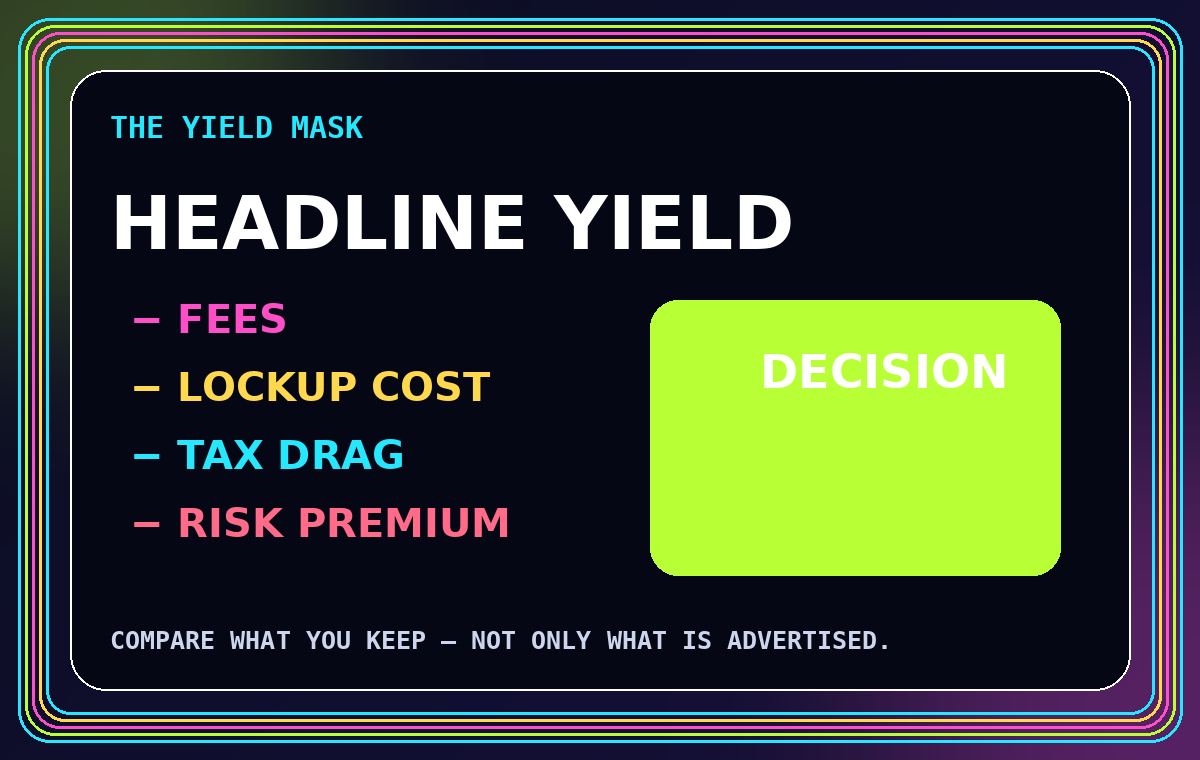
Each guide uses one authoritative external reference and links the mechanism back to practical comparison fields.
Learn why a large distribution rate is not the same as investment return, and how to compare income ETFs using yield definitions, fees, holdings, and total return.
Read the guide
Compare direct Treasury bills with Treasury and government money market funds across yield quotes, maturity, liquidity, fees, reinvestment, and account mechanics.
Read the guide
Learn how to translate APY into estimated monthly income, distinguish simple yield from compounding, and model fees, taxes, rate changes, and withdrawals.
Read the guideThere is no universal best number. Higher yield can reflect greater credit, equity, option, leverage, or concentration risk.
No. SEC yield is a standardized recent-income measure used by many funds, while dividend or distribution metrics use different inputs.
Yes. Portfolio income, option premium, realized gains, policies, and market conditions can change.