Lending markets
Supplier yield depends on borrower demand, utilization, collateral quality, oracles, and liquidation.
DeFi and staking rewards can be genuine compensation for capital, liquidity, or network security. They can also combine variable incentives, smart contracts, leverage, token prices, governance, and delayed exits. YieldMask makes every dependency visible.
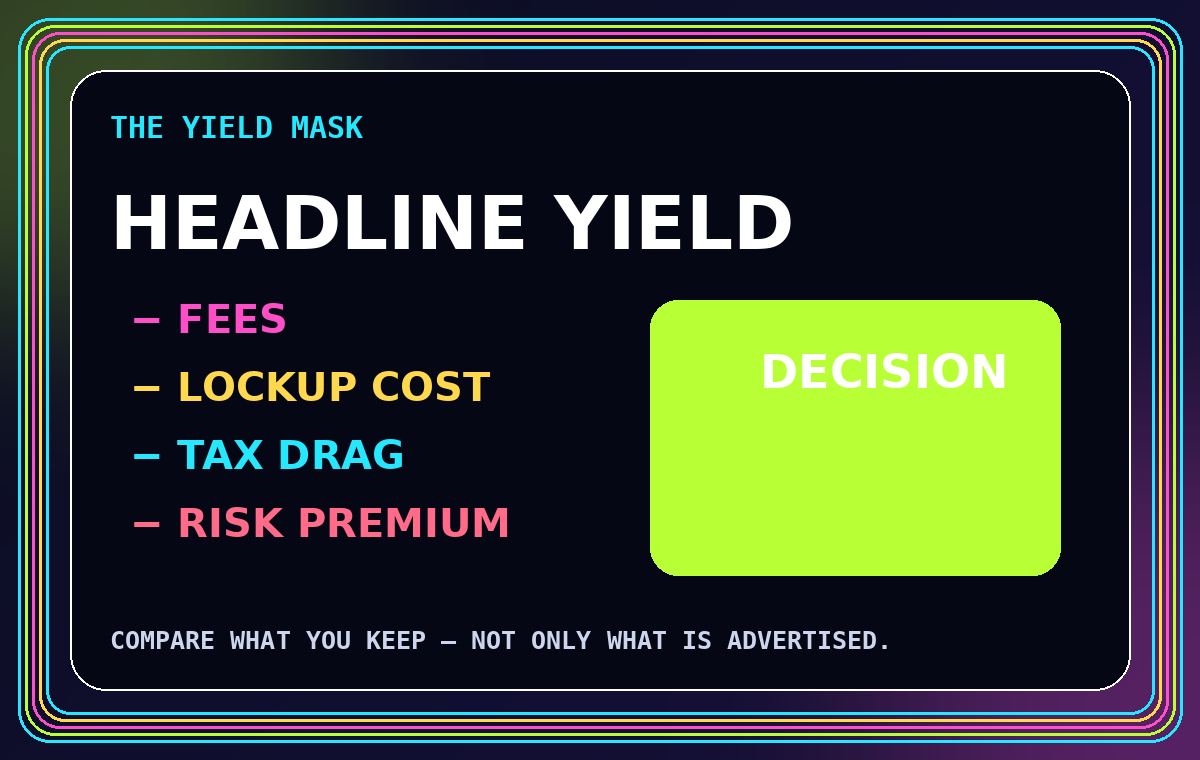
Use the same comparison order every time: define the rate, translate it into dollars, map access, subtract friction, and identify the risk engine.
Supplier yield depends on borrower demand, utilization, collateral quality, oracles, and liquidation.
Fees compensate inventory risk, price divergence, smart contracts, and active range management.
Automation can harvest and compound, while adding strategy code, managers, keepers, and nested protocols.
Rewards pay for network participation and are denominated in the native token, not guaranteed dollars.
Transferability adds a derivative token with redemption, depeg, governance, and contract risk.
Looping a spread magnifies rate changes, collateral moves, and liquidation paths.
These fields turn unlike product pages into a common worksheet. The table is educational and contains no live quotes.
| Strategy | What pays the reward | What can interrupt it |
|---|---|---|
| DeFi lending | Borrower interest and incentives | Low demand, bad debt, illiquidity |
| Liquidity pool | Trading fees and rewards | Price movement, depeg, contract failure |
| Staking | Protocol issuance and network fees | Penalties, validator issues, token price |
| Liquid staking | Staking plus token liquidity | Discount, contract, operator set |
| Leveraged loop | Supply-borrow spread and incentives | Rate inversion and liquidation |
Each guide uses one authoritative external reference and links the mechanism back to practical comparison fields.
A practical way to decompose DeFi lending, liquidity-pool, vault, and incentive yields into fees, leverage, smart-contract, oracle, governance, and exit risk.
Read the guide
Compare ETH and SOL staking by reward source, validator selection, custody, liquidity, token dilution, slashing or penalty exposure, and liquid-staking layers.
Read the guide
A layer-by-layer method for evaluating USDC and USDT income offers without confusing token reserves, platform rewards, lending risk, and DeFi incentives.
Read the guideNo. Native staking supports proof-of-stake consensus, while lending transfers capital for borrower use. Some services bundle the two.
They can trade at a discount or premium depending on liquidity, redemption, confidence, and market conditions.
It may include temporary token incentives, leverage, low liquidity, or assumptions that do not persist.